

CAT-Common Admission Test
- 5000+ Successful Alumni
- 800 + IIM Calls
- 100% GD PI Conversion
- 18+ Years
- 4.8 Google Rating
Announcements
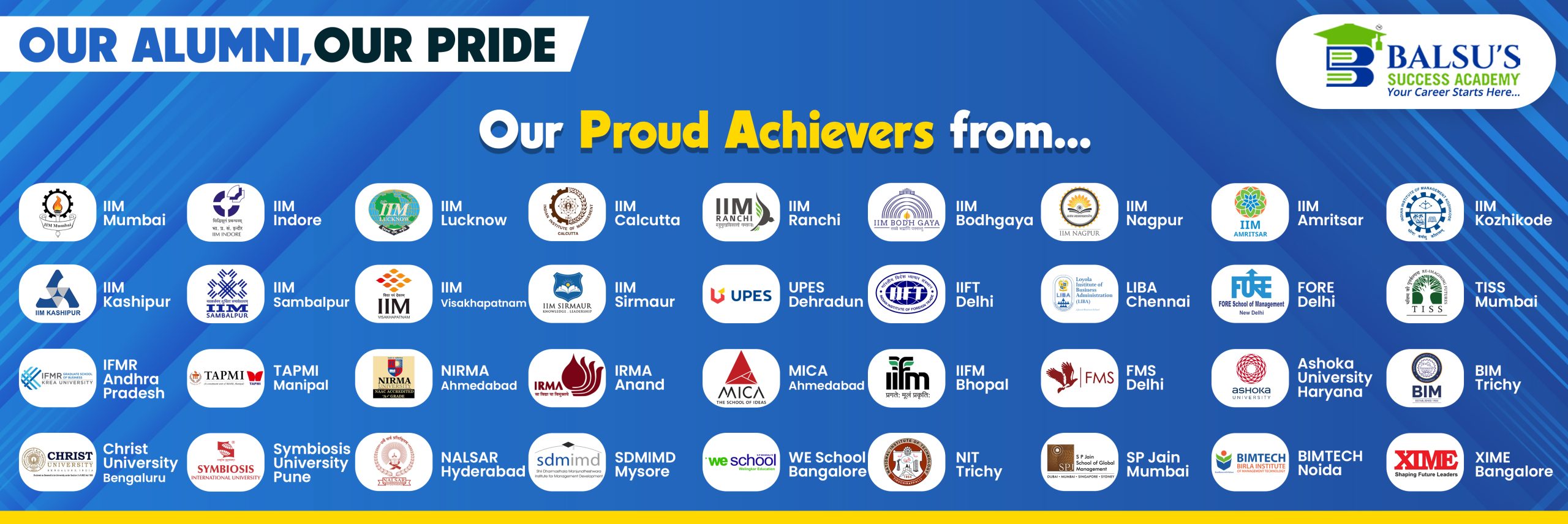
Our Achievers
Know About MBA In A Nutshell
1. Does MBA suit me?
2. From LDC(Madurai) to IIFM(Bhopal)
3. Choosing MBA by rejecting UG placements!
4. All about MBA in 5 mins!
5. Strategies to crack IIM Kozhikode Interview
6. Things you need to know as a MBA Aspirant
7. Is FMS equivalent to IIM?
YOUR PREFERENCE, YOUR CHOICE
@ NO.1 CAT COACHING CENTER IN TAMILNADU



Balsu's CAT Is Packed With

Parents meet

Individual Study Plan for Students

Comprehensive Book material

Internship (Optional)

5000+ Number of Practice questions

300+ hours of Interactive sessions

Alumni Interactive Sessions

Books & Movies Discussion Sessions

40+ hours of CAT intensive Workshop sessions

Current Affairs - Newspaper reading Techniques

Regular update to parents about Student's Performance

One to One Mentoring - Counselling and discussion for students

Regular updates about B-Schools & MBA Entrance Exams notifications

300+ hours of Online Test Practice with National level analysis

80+ hours of Group Discussion, Personal Interview, Written Ability Test

Training for other MBA Entrance Exams (XAT, SNAP, CMAT, IRMASAT, MICAT, NMAT, MAT, TANCET etc…)
MBA EXAMS APPLICATION DEADLINES (as on 04th February, 2026)
| Exam | Deadline | Exam Date | Official Website |
|---|---|---|---|
| CAT | 13 Sept 2025 | 30 Nov 2025 | iimcat.ac.in |
| XAT | 5 Dec 2025 | 4 Jan 2026 | xatonline.in |
| NMAT | 14 Oct 2025 | 5 Nov to 19 Dec 2025 | nmims.edu |
| SNAP | 20 Nov 2025 | 6, 14 & 20 Dec 2025 | snaptest.org |
| MAT (Computer based) | 2 March 2026 | 8 March 2026 | mat.aima.in |
| MAT (Paper based) | 23 Feb 2026 | 1 March 2026 | mat.aima.in |
Disclaimer: Balsu’s Success Academy has created this list from the information available online and hence it is not the opinion of any person in our organisation. Students are required to cross check the data on their own incase there is any discrepancies.
MBA COLLEGES APPLICATION DETAILS (as on 04th February, 2026)
Applications are OPEN for the below mentioned colleges
| College Name | Deadline | Official Link |
|---|---|---|
| SIBM Pune | 05-Dec-2025 | sibm.edu |
| FMS Delhi | 26-Nov-2025 | fms.edu |
| IIFT Delhi (International Business) | 28-Nov-2025 | iift.ac.in |
| TISS Mumbai (HR Program) | 17-Dec-2025 | tiss.ac.in |
| Welingkar (Mumbai, Bangalore) | 16-Jan-2026 | welingkar.org |
| IRMA Gujarat (Rural Management) | 10-Jan-2026 | irma.ac.in |
| SCMHRD Pune | 05-Dec-2025 | scmhrd.edu |
| SIBM Bangalore | 04-Dec-2025 | sibmbengaluru.edu.in |
| SIBM Hyderabad | 12-Jan-2026 | sibmhyd.edu.in |
| SIBM Nagpur | 16-Jan-2026 | sibmnagpur.edu.in |
| SIIB Pune (Intl Business, Agri Business) | 13-Dec-2025 | siib.ac.in |
| SIMC Pune | 19-Jan-2026 | simc.edu |
| SIMS Pune | 08-Jan-2026 | sims.edu |
| SIOM Nashik | 14-Jan-2026 | siom.in |
| XIM Bhuvaneshwar | 10-Jan-2026 | ximb.edu.in |
| XLRI Jamshedpur | 05-Dec-2025 | xlri.ac.in |
| MANAGE Hyderabad (Agri) | 10-Feb-2026 | manage.gov.in |
| ISB Hyderabad (PGP-YL – Round 1) | 14-Dec-2025 | isb.edu |
| MDI Gurgaon | 28-Nov-2025 | mdi.ac.in |
| IMI Delhi | 23-Jan-2026 | imi.edu |
| IMT Ghaziabad | 26-Jan-2026 | imt.edu |
| SP Jain | 28-Nov-2025 | spjimr.org |
| BIMTech Noida | TBD | bimtech.ac.in |
| MICA | 29-Jan-2026 | mica.ac.in |
| FORE Delhi | 05-Jan-2026 | fsm.ac.in |
| Goa Institute of Management | 23-Dec-2025 | gim.ac.in |
| KJ Somaiya | 20-Jan-2026 | kjsim.somaiya.edu |
| TAPMI | 29-Dec-2025 | tapmi.edu.in |
| IFMR Chennai | TBD | krea.edu.in |
| LBSIM Delhi | 15-Jan-2026 | lbsim.ac.in |
| LIBA Chennai | TBD | liba.edu |
| NIRMA Ahmedabad | 15-Jan-2026 | management.nirmauni.ac.in |
| BIM Trichy | 15-Feb-2026 | bim.edu |
| IIFM Bhopal | 15-Jan-2026 | iifm.ac.in |
| Christ University, Bangalore | 25-Jan-2026 | christuniversity.in |
| SDMIMD Mysore | 28-Feb-2026 | sdmimd.ac.in |
| TSM Madurai | TBD | tsm.ac.in |
| NAARM Hyderabad (Agri) | 28-Feb-2026 | naarm.org.in |
| UPES Dehradun | TBD | upes.ac.in |
| NIT Suratkal (Hardcopy Application receiving date) | 10-Apr-2026 | nitk.ac.in |
TBD-To be disclosed
Disclaimer: Balsu’s Success Academy has created this list from the information available online and hence it is not the opinion of any person in our organisation. Students are required to cross check the data on their own incase there is any discrepancies.
Balsu's CAT Is Packed With
Parents meet
(as on 15th Oct, 2025)
Individual Study Plan for Students
Comprehensive Book material
Internship (Optional)
5000+ Number of Practice questions
300+ hours of Interactive sessions
Alumni Interactive Sessions
Books & Movies Discussion Sessions
40+ hours of CAT intensive Workshop sessions
Current Affairs - Newspaper reading Techniques
Regular update to parents about Student's Performance
One to One Mentoring - Counselling and discussion for students
Regular updates about B-Schools & MBA Entrance Exams notifications
300+ hours of Online Test Practice with National level analysis
80+ hours of Group Discussion, Personal Interview, Written Ability Test
Training for other MBA Entrance Exams (XAT, SNAP, CMAT, IRMASAT, MICAT, NMAT, MAT, TANCET etc…)
Balsu's CAT Is Packed With
Parents meet
Individual Study Plan for Students
Comprehensive Book material
Internship (Optional)
5000+ Number of Practice questions
300+ hours of Interactive sessions
Alumni Interactive Sessions
Books & Movies Discussion Sessions
40+ hours of CAT intensive Workshop sessions
Current Affairs - Newspaper reading Techniques
Regular update to parents about Student's Performance
One to One Mentoring - Counselling and discussion for students
Regular updates about B-Schools & MBA Entrance Exams notifications
300+ hours of Online Test Practice with National level analysis
80+ hours of Group Discussion, Personal Interview, Written Ability Test
Training for other MBA Entrance Exams (XAT, SNAP, CMAT, IRMASAT, MICAT, NMAT, MAT, TANCET etc…)
Unique @Balsu’s Success Academy
Smaller batch sizes – To focus on student’s personal attention
Detailed Test Analysis and Individual Feedback
Separate sessions for Group Discussions and Personal Interview process (GD/PI/WAT)
Prompt doubt clarification sessions!
Strong Alumni base
Regular updates to Parents on colleges selections, Loan Procedures
Updated Study material & Mock test series to match the changing trends of the exams
Consistently produced Toppers/Achievers for 15+ years
Professional as well as Personal Development
Want A Demo?
CLICK HERE TO REGISTER FOR A FREE
Our College Wise Achievers







Proud Moments







FAQ
The Common Admission Test (CAT) is India's most prestigious MBA entrance examination conducted
every year by the Indian Institutes of Management (IIMs). It is the gateway to admission into the 21
IIMs and more than 1,300 leading business schools across India.
CAT evaluates candidates in three key areas: Verbal Ability & Reading Comprehension (VARC), Data
Interpretation & Logical Reasoning (DILR), and Quantitative Aptitude (QA). A high CAT percentile can
help students secure admission to top MBA colleges and pursue careers in consulting, finance,
marketing, analytics, operations, and entrepreneurship.
Answered by Balsu
20+ Years mentoring students
5000+ students mentored successfully
CAT stands for Common Admission Test. It is a national-level MBA entrance examination conducted
annually by one of the Indian Institutes of Management (IIMs) on a rotational basis.
The CAT exam is accepted by all IIMs and several prestigious business schools such as FMS Delhi,
SPJIMR Mumbai, MDI Gurgaon, IITs, IMI, TAPMI, and many others. It is considered one of the most
competitive MBA entrance exams in India.
Answered by Balsu
20+ Years mentoring students
5000+ students mentored successfully
The CAT exam is the most widely accepted MBA entrance test in India. A good CAT score can help
you gain admission to the country's top management institutes, leading to better career
opportunities, higher salary packages, strong industry exposure, and leadership roles.
Apart from the IIMs, many leading private and government business schools also accept CAT scores,
making it one of the best options for students aspiring to build successful careers in management
and business.
Answered by Balsu
20+ Years mentoring students
5000+ students mentored successfully
CAT is suitable for graduates and final-year undergraduate students who aspire to pursue an MBA or
PGDM from top business schools.
Whether you are an Engineering, Commerce, Arts, Science, Law, Pharmacy, Agriculture, or Medical
graduate, CAT can help you build a career in business management, consulting, marketing, finance,
analytics, operations, human resources, or entrepreneurship.
Answered by Balsu
20+ Years mentoring students
5000+ students mentored successfully
No. CAT is open to students from all academic backgrounds. Graduates in Commerce, Arts, Science,
Law, Medicine, Agriculture, Pharmacy, and other disciplines are equally eligible to appear for the exam.
In fact, many IIMs encourage academic diversity during admissions, giving additional consideration
to students from non-engineering backgrounds. Your success in CAT depends on your preparation
and aptitude—not your degree.
Answered by Balsu
20+ Years mentoring students
5000+ students mentored successfully
More than 3 lakh students register for the CAT exam every year, making it one of India's largest and
most competitive MBA entrance examinations.
Despite the high number of applicants, only a small percentage secure admission to the IIMs.
However, thousands of students also gain admission to other top MBA colleges that accept CAT
scores, making the exam valuable even if you don't get into an IIM.
Answered by Balsu
20+ Years mentoring students
5000+ students mentored successfully
CAT is a competitive examination, but it is not impossible to crack. The exam tests aptitude, logical
reasoning, problem-solving ability, and reading comprehension rather than memorisation.
Students who prepare consistently, take regular mock tests, analyse their mistakes, and improve
their time management often perform exceptionally well. Many students from government colleges
and Tier-2 and Tier-3 cities have successfully secured admission to top IIMs through disciplined
preparation.
Answered by Balsu
20+ Years mentoring students
5000+ students mentored successfully
Cracking CAT offers numerous long-term career benefits. It provides access to premier MBA
institutions, excellent placement opportunities, higher salary packages, industry networking, global
exposure, and leadership development.
Graduates from top MBA colleges often work in multinational companies, startups, consulting firms,
banks, technology companies, and global organizations. A good CAT score can significantly improve
your career growth and earning potential.
Answered by Balsu
20+ Years mentoring students
5000+ students mentored successfully
No. Although CAT is conducted by the IIMs, its scores are accepted by more than 1,300 business
schools across India.
Top institutions like FMS Delhi, SPJIMR Mumbai, MDI Gurgaon, IIT Delhi, IIT Bombay, IIT Madras, IMI
New Delhi, Great Lakes, FORE School of Management, BIM Trichy, and several other reputed MBA
colleges use CAT scores for admission.
This makes CAT one of the most widely accepted MBA entrance examinations in the country.
Answered by Balsu
20+ Years mentoring students
5000+ students mentored successfully
Yes. If you aspire to build a successful career in management, business, consulting, finance,
marketing, analytics, or entrepreneurship, CAT is one of the best investments you can make in your future.
Preparing for CAT not only improves your chances of getting into a top MBA college but also
develops essential skills such as critical thinking, logical reasoning, quantitative aptitude,
communication, and decision-making—skills that are highly valued by employers across industries.
Answered by Balsu
20+ Years mentoring students
5000+ students mentored successfully
Candidates who have completed a bachelor's degree from a recognized university with at least 50%
aggregate marks (45% for SC, ST, and PwD candidates) are eligible to appear for the CAT exam.
Students who are in the final year of their undergraduate degree can also apply, provided they
complete their graduation within the timeline specified by the admitting institute.
CAT is open to graduates from all disciplines, including Engineering, Commerce, Arts, Science, Law,
Medicine, Agriculture, and Pharmacy.
Answered by Balsu
20+ Years mentoring students
5000+ students mentored successfully
Yes. Final-year undergraduate students are eligible to apply for the CAT exam, even if their final
semester results are pending at the time of registration.
If selected by an IIM or another MBA institute, candidates must submit proof of completing their
bachelor's degree within the deadlines prescribed by the respective institution.
Answered by Balsu
20+ Years mentoring students
5000+ students mentored successfully
No. There is no minimum or maximum age limit for appearing in the CAT exam.
Whether you are a fresh graduate, a working professional, or someone planning a career change
after several years of work experience, you can apply for CAT as long as you meet the educational
eligibility criteria.
Answered by Balsu
20+ Years mentoring students
5000+ students mentored successfully
To be eligible for CAT, candidates must hold a bachelor's degree from a recognized university or
institution.
General, EWS, and NC-OBC candidates must have secured at least 50% aggregate marks, while SC,
ST, and PwD candidates require 45% aggregate marks. Candidates awaiting their final results may
also apply.
Answered by Balsu
20+ Years mentoring students
5000+ students mentored successfully
A diploma alone does not make a candidate eligible for CAT.
Since CAT requires a recognized bachelor's degree, students who have only completed a diploma
must first complete an eligible undergraduate program before they can apply. However, candidates
who completed a diploma and later earned a bachelor's degree are fully eligible.
Answered by Balsu
20+ Years mentoring students
5000+ students mentored successfully
Yes. CAT is open to graduates from all academic streams.
Whether you have studied Engineering, B.Com, BBA, BA, B.Sc, BCA, MBBS, BDS, Law, Agriculture,
Pharmacy, Architecture, Design, or any other recognized bachelor's program, you are eligible to
appear for CAT if you satisfy the minimum percentage requirements.
Answered by Balsu
20+ Years mentoring students
5000+ students mentored successfully
Absolutely. Working professionals are eligible to appear for CAT regardless of their years of work
experience.
In fact, many IIMs value quality work experience during the admission process. Professionals
preparing alongside their jobs often bring practical business knowledge that strengthens their MBA
applications.
Answered by Balsu
20+ Years mentoring students
5000+ students mentored successfully
Yes. Candidates who are in the final year of graduation and have pending backlogs can still register
for CAT.
However, they must successfully complete all degree requirements and produce the necessary
academic documents before joining the MBA program, if selected by an institute.
Answered by Balsu
20+ Years mentoring students
5000+ students mentored successfully
Yes. Indian citizens, Non-Resident Indians (NRIs), Overseas Citizens of India (OCIs), and foreign
nationals may be eligible to apply, depending on the admission policies of the participating
institutions.
While many international candidates choose exams like the GMAT, CAT remains an option for those
seeking admission to MBA programs that accept CAT scores.
Answered by Balsu
20+ Years mentoring students
5000+ students mentored successfully
It depends on your graduation percentage.
Candidates belonging to the General, EWS, and NC-OBC categories must have at least 50% aggregate
marks, while SC, ST, and PwD candidates need 45% aggregate marks to meet CAT eligibility
requirements.
Even if you meet the minimum eligibility criteria, securing admission to top MBA colleges depends
on several factors such as your CAT percentile, academic profile, work experience, diversity, and
interview performance.
Answered by Balsu
20+ Years mentoring students
5000+ students mentored successfully
Structured CAT coaching can significantly improve your preparation by providing expert guidance, a
well-planned study schedule, mock tests, doubt-clearing sessions, and personalized feedback.
However, CAT coaching is not compulsory to crack the exam. Many students have successfully
secured admission to top IIMs through self-study.
If you are unsure about where to start, struggle with consistency, or want to maximize your CAT
percentile, coaching can save time and help you avoid common preparation mistakes.
Answered by Balsu
20+ Years mentoring students
5000+ students mentored successfully
The best CAT coaching institute should offer experienced faculty, updated study materials, regular
mock tests, one-to-one mentoring, performance analysis, and doubt-solving sessions.
Before joining a coaching institute, consider:
Choosing the right coaching institute can make your CAT preparation more structured and efficient.
Answered by Balsu
20+ Years mentoring students
5000+ students mentored successfully
A high-quality CAT coaching program should help students improve both concepts and test-taking strategies.
Look for features such as:
The right coaching program focuses not only on completing the syllabus but also on improving your overall exam performance.
Answered by Balsu
20+ Years mentoring students
5000+ students mentored successfully
Yes, online CAT coaching can be just as effective as classroom coaching when it includes live classes,
recorded sessions, interactive doubt-solving, mock tests, and regular mentor support.
Online coaching offers flexibility for college students and working professionals, allowing them to
learn at their own pace while saving travel time. The best choice depends on your learning style,
schedule, and level of self-discipline.
Answered by Balsu
20+ Years mentoring students
5000+ students mentored successfully
The ideal time to begin CAT coaching is 9 to 12 months before the exam. This gives you enough time
to build strong fundamentals, practice extensively, take multiple mock tests, and improve weak
areas.
Students with a strong aptitude may prepare in 6 months, while beginners often benefit from
starting earlier to avoid unnecessary pressure closer to the exam.
Answered by Balsu
20+ Years mentoring students
5000+ students mentored successfully
Yes. Many CAT coaching institutes offer weekend, evening, and online batches specifically designed
for working professionals.
With proper planning and consistent effort, working professionals can successfully prepare for CAT
without leaving their jobs. A flexible coaching schedule combined with expert guidance helps
maintain preparation alongside professional responsibilities.
Answered by Balsu
20+ Years mentoring students
5000+ students mentored successfully
The duration of CAT coaching depends on your current aptitude and preparation level.
Quality of preparation is more important than the number of months spent in coaching.
Answered by Balsu
20+ Years mentoring students
5000+ students mentored successfully
Most reputed CAT coaching institutes provide comprehensive mock test series along with detailed
performance analysis.
Mock tests help students:
Regular analysis of mock tests is one of the most important factors in improving your CAT percentile.
Answered by Balsu
20+ Years mentoring students
5000+ students mentored successfully
Yes. Personalized mentoring helps students receive guidance based on their individual strengths,
weaknesses, and learning pace.
A mentor can assist with:
One-to-one mentoring is particularly beneficial for students aiming for high CAT percentiles.
Answered by Balsu
20+ Years mentoring students
5000+ students mentored successfully
Balsu Guru focuses on building strong concepts, strategic preparation, and personalized mentoring
rather than simply completing the syllabus.
Students benefit from:
Our goal is to help students not only achieve a high CAT percentile but also gain admission to the
MBA college that best aligns with their career aspirations.
Answered by Balsu
20+ Years mentoring students
5000+ students mentored successfully
The first step in CAT preparation is understanding the exam pattern and syllabus. CAT consists of
three sections: Verbal Ability & Reading Comprehension (VARC), Data Interpretation & Logical
Reasoning (DILR), and Quantitative Aptitude (QA).
Begin by assessing your strengths and weaknesses through a diagnostic test. Create a realistic study
plan, focus on building strong fundamentals, and practice daily. Regular mock tests and performance
analysis are essential to improve accuracy, speed, and confidence.
Consistency is the key to achieving a high CAT percentile.
Answered by Balsu
20+ Years mentoring students
5000+ students mentored successfully
The ideal preparation time depends on your current aptitude and academic background.
Rather than focusing on the number of months, aim for consistent daily preparation and regular
revision.
Answered by Balsu
20+ Years mentoring students
5000+ students mentored successfully
Yes. Many students crack CAT through self-study by using quality books, online resources, mock
tests, and disciplined preparation.
However, coaching provides structured learning, expert mentorship, personalized feedback, and
regular performance analysis. Students who need guidance, motivation, or a structured study plan
often benefit significantly from coaching.
Whether you choose self-study or coaching, dedication and consistency remain the most important
factors.
Answered by Balsu
20+ Years mentoring students
5000+ students mentored successfully
The number of study hours depends on your schedule and current level of preparation.
Quality of study is more important than the total number of hours. Focus on concept building, timed
practice, and regular mock tests rather than simply increasing study time.
Answered by Balsu
20+ Years mentoring students
5000+ students mentored successfully
A successful CAT study plan should include:
Following a structured study plan helps maintain consistency and improves overall performance.
Answered by Balsu
20+ Years mentoring students
5000+ students mentored successfully
Some of the most recommended books for CAT preparation include:
Apart from books, regular newspaper reading and mock test analysis play an important role in CAT
preparation.
Answered by Balsu
20+ Years mentoring students
5000+ students mentored successfully
Yes. Mock tests are one of the most important components of CAT preparation.
They help students:
Equally important is analyzing each mock test to understand mistakes and avoid repeating them.
Answered by Balsu
20+ Years mentoring students
5000+ students mentored successfully
Improving your CAT percentile requires more than just studying harder. It requires studying smarter.
Focus on:
Small improvements over several months often lead to significant percentile gains.
Answered by Balsu
20+ Years mentoring students
5000+ students mentored successfully
Absolutely.
Thousands of working professionals crack CAT every year while managing full-time jobs.
A well-planned study schedule, focused preparation during weekdays, longer study sessions on
weekends, and regular mock tests can help working professionals perform exceptionally well. Online
coaching and flexible learning schedules also make CAT preparation more convenient.
Answered by Balsu
20+ Years mentoring students
5000+ students mentored successfully
Many students lose valuable marks because of avoidable mistakes such as:
Avoiding these mistakes can significantly improve your preparation and increase your chances of
achieving a high CAT percentile.
Answered by Balsu
20+ Years mentoring students
5000+ students mentored successfully
CAT mock tests are one of the most effective tools for improving your CAT performance. They
simulate the actual exam environment and help you understand the exam pattern, manage time
efficiently, and build confidence before the final exam.
Regular mock tests also help identify your strengths and weaknesses, allowing you to focus on areas
that need improvement. Students who consistently take and analyze mock tests are more likely to
achieve a higher CAT percentile.
Answered by Balsu
20+ Years mentoring students
5000+ students mentored successfully
You should begin taking mock tests after completing your basic concepts in Quantitative Aptitude,
Verbal Ability, and Data Interpretation & Logical Reasoning.
Most experts recommend starting with one mock test every two to three weeks during the early
stages of preparation. As the CAT exam approaches, increase the frequency to one or two mock tests
every week. The final two months should include regular full-length mock tests followed by detailed
analysis.
Answered by Balsu
20+ Years mentoring students
5000+ students mentored successfully
There is no fixed number, but most high-percentile candidates attempt 30 to 50 full-length CAT
mock tests during their preparation.
The goal is not simply to complete as many mocks as possible but to analyze every test carefully,
understand mistakes, improve accuracy, and refine your exam strategy.
Quality analysis after each mock test is more valuable than taking a large number of tests without
reviewing your performance.
Answered by Balsu
20+ Years mentoring students
5000+ students mentored successfully
Yes. Good-quality CAT mock tests are designed to closely replicate the actual CAT exam in terms of
difficulty level, question types, sectional timing, and overall exam experience.
Taking mocks under exam-like conditions helps students become familiar with the pressure of the
real test and improves their confidence and decision-making skills.
Answered by Balsu
20+ Years mentoring students
5000+ students mentored successfully
Analyzing a mock test is as important as taking it.
After every mock test, review:
Use these insights to revise concepts and improve your strategy for the next mock test.
Answered by Balsu
20+ Years mentoring students
5000+ students mentored successfully
A good mock test score depends on your target percentile and the difficulty level of the mock.|
Instead of comparing scores with others, focus on:
Remember that CAT mock scores may differ from your actual CAT performance, especially if you use
them effectively for learning.
Answered by Balsu
20+ Years mentoring students
5000+ students mentored successfully
Both are important.
Sectional tests help strengthen individual areas such as VARC, DILR, or QA by focusing on specific
concepts and question types.
Full-length mock tests prepare you for the complete CAT exam experience, helping you manage
time, build stamina, and develop an effective attempt strategy.
A balanced preparation plan should include both sectional tests and full-length mocks.
Answered by Balsu
20+ Years mentoring students
5000+ students mentored successfully
Many students fail to get the full benefit of mock tests because they:
Treat every mock test as a learning opportunity rather than a performance evaluation.
Answered by Balsu
20+ Years mentoring students
5000+ students mentored successfully
Yes. Regular mock tests can significantly improve your CAT percentile when combined with proper analysis and revision.|
Mock tests help you:
Students who consistently learn from their mock tests often see steady improvement in their percentile over time.
Answered by Balsu
20+ Years mentoring students
5000+ students mentored successfully
Balsu Guru's CAT Mock Tests are designed to replicate the actual CAT exam experience while
providing detailed performance insights.
Students receive:
Our goal is not just to help students practice but to help them understand their performance and
steadily improve their CAT percentile.
Answered by Balsu
20+ Years mentoring students
5000+ students mentored successfully
The CAT syllabus is broadly divided into three sections:
Para Summary, Odd One Out, and Sentence Completion.
Arrangements, Puzzles, Caselets, and Logical Reasoning Sets.
Mathematics, and Mensuration.
Although the CAT conducting IIM does not officially release a detailed syllabus every year, these
topics are consistently tested based on previous exam patterns.
Answered by Balsu
20+ Years mentoring students
5000+ students mentored successfully
The core CAT syllabus has remained largely consistent over the years, although the exam pattern and
distribution of questions may change slightly.
The IIMs may modify the number of questions or the weightage of certain topics, but the three
major sections—VARC, DILR, and QA—continue to form the foundation of the CAT exam.
Students should focus on concept clarity rather than trying to predict minor changes in the syllabus.
Answered by Balsu
20+ Years mentoring students
5000+ students mentored successfully
No. The Indian Institutes of Management (IIMs) do not publish a detailed official CAT syllabus.
The syllabus followed by coaching institutes and MBA aspirants is based on an analysis of previous
years' CAT question papers and exam trends. Therefore, preparing according to the commonly
accepted syllabus is the best strategy.
Answered by Balsu
20+ Years mentoring students
5000+ students mentored successfully
All three sections are equally important because candidates must perform well in each to achieve a
high overall percentile and meet sectional cut-offs.
However, the level of difficulty may vary from year to year. Students should prepare all three
sections—VARC, DILR, and QA—with equal dedication instead of focusing only on their strengths.
Balanced preparation leads to better overall performance.
Answered by Balsu
20+ Years mentoring students
5000+ students mentored successfully
No. The CAT exam does not include General Knowledge (GK) or Current Affairs as part of its written
examination.
Instead, CAT focuses on aptitude, logical reasoning, quantitative ability, and reading comprehension.
However, students should stay updated with current affairs because they may be useful during the
Group Discussion (GD), Written Ability Test (WAT), or Personal Interview (PI) rounds conducted by
some MBA institutes.
Answered by Balsu
20+ Years mentoring students
5000+ students mentored successfully
Yes, Quantitative Aptitude is one of the three sections in CAT. However, the mathematics tested is
primarily based on concepts taught up to Class 10.
Topics such as Arithmetic, Algebra, Geometry, Number System, and Mensuration are more
important than advanced mathematics. Students from non-mathematics backgrounds can also
perform well with consistent practice.
Answered by Balsu
20+ Years mentoring students
5000+ students mentored successfully
The Quantitative Aptitude section mainly focuses on:
Among these, Arithmetic and Algebra generally carry significant weight in the CAT exam. Students
should master these topics before moving on to advanced concepts.
Answered by Balsu
20+ Years mentoring students
5000+ students mentored successfully
The Verbal Ability & Reading Comprehension (VARC) section evaluates a student's reading ability,
vocabulary in context, grammar application, and logical understanding of written passages.
Important topics include:
Developing a daily reading habit can significantly improve performance in this section.
Answered by Balsu
20+ Years mentoring students
5000+ students mentored successfully
The Data Interpretation & Logical Reasoning (DILR) section assesses analytical thinking and logical
problem-solving.
Common topics include:
Regular practice of diverse question sets is the best way to improve DILR performance.
Answered by Balsu
20+ Years mentoring students
5000+ students mentored successfully
The best approach to completing the CAT syllabus is to follow a structured preparation plan.
Start by understanding the fundamentals of each topic, then solve topic-wise practice questions
before moving on to sectional tests. Once the syllabus is covered, begin taking full-length mock tests
and analyze your performance to identify weak areas.
Revision, consistent practice, and regular mock tests are essential for mastering the CAT syllabus and
achieving a high percentile.
Answered by Balsu
20+ Years mentoring students
5000+ students mentored successfully
The CAT (Common Admission Test) is a computer-based entrance exam conducted annually by the
Indian Institutes of Management (IIMs). The exam is divided into three sections:
Candidates must attempt the sections in the prescribed order, with a fixed time limit for each. The
CAT exam tests analytical thinking, logical reasoning, reading ability, and quantitative aptitude rather
than subject-specific knowledge.
Understanding the CAT exam pattern is the first step toward creating an effective preparation
strategy.
Answered by Balsu
20+ Years mentoring students
5000+ students mentored successfully
The CAT exam consists of three sections, each designed to evaluate a different set of skills:
reasoning, and language skills.
and decision-making ability.
problem-solving skills.
Performing well in all three sections is important because many top MBA colleges have sectional cut-
off requirements in addition to the overall CAT percentile.
Answered by Balsu
20+ Years mentoring students
5000+ students mentored successfully
The CAT exam is conducted over 120 minutes (2 hours). Candidates are given 40 minutes for each of
the three sections, and they cannot switch between sections during the exam.
This sectional time limit makes time management an important part of CAT preparation. Practicing
full-length mock tests helps students become familiar with the timing and improve their
performance under exam conditions.
Answered by Balsu
20+ Years mentoring students
5000+ students mentored successfully
The number of questions in CAT may vary slightly from year to year, but the exam generally contains
around 65–70 questions across the three sections.
The IIMs may revise the number of questions or the distribution among sections based on the exam
pattern for that year. Therefore, students should stay updated with the latest CAT notification while
focusing on concept-based preparation.
Answered by Balsu
20+ Years mentoring students
5000+ students mentored successfully
Yes. CAT follows a negative marking system for most Multiple Choice Questions (MCQs).
Generally:
responses.
Students should avoid random guessing and focus on improving accuracy through regular practice.
Answered by Balsu
20+ Years mentoring students
5000+ students mentored successfully
No. CAT has a sectional time limit, and candidates must complete one section before moving to the
next.
You cannot return to a previous section once the allotted time has ended. This makes sectional
preparation and time management essential for achieving a high percentile.
Answered by Balsu
20+ Years mentoring students
5000+ students mentored successfully
The CAT exam is conducted in Computer-Based Test (CBT) mode at designated test centres across
India.
Candidates answer questions using a computer, but no advanced computer skills are required. A
simple on-screen interface allows students to navigate questions, mark answers, and review
responses within the allotted time.
Answered by Balsu
20+ Years mentoring students
5000+ students mentored successfully
The CAT exam includes two main types of questions:
given options.
options.
The exam emphasizes logical reasoning, comprehension, and problem-solving rather than rote
memorization. Students should practice both MCQs and TITA questions as part of their preparation.
Answered by Balsu
20+ Years mentoring students
5000+ students mentored successfully
The overall structure of CAT remains consistent, but the conducting IIM may make minor changes to
the number of questions, section-wise distribution, or difficulty level.
Instead of worrying about possible changes, students should focus on mastering the syllabus, taking
regular mock tests, and staying updated with the official CAT notification released each year.
Answered by Balsu
20+ Years mentoring students
5000+ students mentored successfully
Understanding the CAT exam pattern helps students prepare more effectively by improving time
management, section-wise strategy, and question selection.
When you know the exam format, marking scheme, sectional timing, and question types, you can
plan your preparation, reduce exam-day stress, and make better decisions during the test. Regular
mock tests based on the latest CAT exam pattern further improve confidence and overall
performance.
Answered by Balsu
20+ Years mentoring students
5000+ students mentored successfully
A high CAT percentile is essential for admission to IIM Ahmedabad, but it is not the only selection
criterion. Generally:
policies.
Apart from CAT score, IIM Ahmedabad considers:
A 99.9 percentile does not guarantee admission, while candidates with slightly lower percentiles
have secured admission due to strong overall profiles.
Answered by Balsu
20+ Years mentoring students
5000+ students mentored successfully
The required CAT percentile varies across IIMs.
Approximate competitive percentiles are:
| IIM Category | Safe CAT Percentile |
|---|---|
| IIM Ahmedabad, Bangalore, Calcutta | 99.5+ |
| IIM Lucknow, Kozhikode, Indore | 98–99.5 |
| IIM Shillong, Mumbai | 96–98.5 |
| New IIMs | 90–96 |
| Baby IIMs | 85–92 |
Actual admission depends on category, academic profile, work experience, and interview
performance.
Answered by Balsu
20+ Years mentoring students
5000+ students mentored successfully
Many aspirants confuse CAT percentile with CAT cutoff.
CAT Percentile is your relative performance compared to other test-takers.
CAT Cutoff is the minimum percentile required to become eligible for the next stage of admission.
For example:
You qualify for shortlisting, but final admission still depends on GD/WAT/PI, academics, work
experience, and profile score.
Clearing the cutoff only makes you eligible—it does not guarantee admission.
Answered by Balsu
20+ Years mentoring students
5000+ students mentored successfully
Although cutoffs change slightly every year, they remain fairly stable.
| Institute | Approximate CAT Cutoff |
|---|---|
| IIM Ahmedabad | 80 Overall (Official), 99.5+ Competitive |
| IIM Bangalore | 85 Overall (Official), 99+ Competitive |
| IIM Calcutta | 85 Overall (Official), 99+ Competitive |
| IIM Lucknow | 90 Overall |
| IIM Kozhikode | 85 Overall |
| IIM Indore | 90 Overall |
Remember that official minimum cutoffs are only eligibility criteria. Final shortlisted candidates
usually have much higher percentiles.
Answered by Balsu
20+ Years mentoring students
5000+ students mentored successfully
One of the most common questions among CAT aspirants is whether cutoffs are increasing every year.
The answer is not significantly.
Recent trends show:
Instead of chasing cutoff changes, aspirants should focus on maximizing their percentile.
Answered by Balsu
20+ Years mentoring students
5000+ students mentored successfully
Since CAT difficulty changes every year, the score required for a percentile also changes.
Approximate recent trends are:
| Percentile | Approximate CAT Score |
|---|---|
| 99.9 | 110–125 |
| 99.5 | 95–105 |
| 99 | 80–90 |
| 95 | 60–70 |
| 90 | 45–55 |
| 80 | 32–40 |
These values are approximate and vary each year depending on normalization and exam difficulty.
Answered by Balsu
20+ Years mentoring students
5000+ students mentored successfully
Yes.
Almost every IIM considers sectional performance.
Suppose you score:
You may still not receive interview calls from several IIMs because you failed to meet the sectional cutoff.
Most top IIMs expect:
Preparing all three sections equally is essential.
Answered by Balsu
20+ Years mentoring students
5000+ students mentored successfully
Yes.
A 90 percentile can fetch interview calls from several institutes, particularly:
For reserved category candidates with strong academic records, even some older IIMs may become achievable.
A good profile, work experience, and interview performance significantly improve admission chances.
Answered by Balsu
20+ Years mentoring students
5000+ students mentored successfully
Yes.
CAT uses percentile rather than raw marks because the exam difficulty varies every year.
If the paper is difficult:
For example:
This is why aspirants should focus on maximizing percentile instead of targeting a fixed score.
Answered by Balsu
20+ Years mentoring students
5000+ students mentored successfully
Some consistent trends observed in recent CAT admissions include:
than ever before.
Candidates should prepare with a holistic admission strategy rather than focusing only on CAT
percentile.
Answered by Balsu
20+ Years mentoring students
5000+ students mentored successfully
CAT scores are accepted by all 21 Indian Institutes of Management (IIMs) and more than 1,300
leading MBA colleges across India.
Some of the top institutes accepting CAT scores include:
A good CAT percentile opens admission opportunities across government, private, and autonomous
business schools.
Answered by Balsu
20+ Years mentoring students
5000+ students mentored successfully
India currently has 21 Indian Institutes of Management (IIMs) spread across different states.
These institutes are categorized into:
Each IIM has its own admission criteria, fee structure, placement records, and specialization
offerings. Students should compare institutes based on their career goals rather than relying only on
rankings.
Answered by Balsu
20+ Years mentoring students
5000+ students mentored successfully
Some of the most prestigious IIMs based on academic reputation, faculty, placements, alumni
network, and industry recognition include:
These institutes consistently attract top recruiters and offer excellent career opportunities in
consulting, finance, marketing, operations, product management, and entrepreneurship.
The "best" IIM ultimately depends on your specialization, career aspirations, and return on
investment.
Answered by Balsu
20+ Years mentoring students
5000+ students mentored successfully
Yes, admission to certain IIMs may be possible with a 90 percentile, depending on factors such as
your category, academic background, work experience, gender diversity, and interview
performance.
While the older IIMs usually require very high percentiles for General category candidates, several
newer IIMs consider candidates with lower percentiles if they have a strong overall profile.
Always check the admission policy of each IIM before applying.
Answered by Balsu
20+ Years mentoring students
5000+ students mentored successfully
For many students, an MBA from an IIM offers excellent value due to its strong academic curriculum,
experienced faculty, industry exposure, extensive alumni network, and outstanding placement
opportunities.
Graduates from leading IIMs often secure leadership roles in consulting firms, multinational
corporations, financial institutions, technology companies, and startups. Beyond salary, an IIM MBA
also helps develop managerial skills, business acumen, and lifelong professional connections.
Answered by Balsu
20+ Years mentoring students
5000+ students mentored successfully
The IIMs are autonomous institutions recognized for their rigorous academic standards, competitive
admissions, experienced faculty, research output, and strong placement records.
However, several non-IIM institutions such as FMS Delhi, SPJIMR Mumbai, MDI Gurgaon, XLRI
(through XAT), and IIT management departments also provide excellent MBA education.
Students should compare colleges based on curriculum, specialization, placements, fees, alumni
network, and career outcomes rather than focusing only on the institution's name.
Answered by Balsu
20+ Years mentoring students
5000+ students mentored successfully
Several reputed MBA colleges accept candidates with CAT percentiles in the 80–90 range, depending
on the admission cycle and candidate profile.
These may include:
Students should evaluate colleges based on placement outcomes, faculty quality, industry exposure,
fees, and return on investment rather than percentile alone.
Answered by Balsu
20+ Years mentoring students
5000+ students mentored successfully
The best MBA specialization depends on your interests, skills, and long-term career goals.
Popular specializations include:
Before choosing a specialization, consider industry demand, career growth, placement
opportunities, and your strengths.
Answered by Balsu
20+ Years mentoring students
5000+ students mentored successfully
No. Placement statistics vary across IIMs based on factors such as institute reputation, recruiter
participation, student batch size, and market conditions.
Older IIMs generally attract a wider range of recruiters and may report higher average salary
packages. However, many newer IIMs have also built strong placement records and offer excellent
career opportunities.
Students should look beyond salary figures and consider role quality, recruiter diversity, alumni
network, and career progression.
Answered by Balsu
20+ Years mentoring students
5000+ students mentored successfully
Choosing the right MBA college involves more than just looking at rankings.
Consider the following factors:
A well-informed decision can have a lasting impact on your career, so compare colleges carefully
before making your final choice.
Answered by Balsu
20+ Years mentoring students
5000+ students mentored successfully
One of the biggest reasons candidates prepare for CAT is the excellent placement opportunities
offered by IIMs and other top B-schools. However, salary packages vary depending on the
institute, specialization, industry, work experience, and market conditions.
Based on recent placement trends:
| Institute Category | Average Salary (Approx.) |
|---|---|
| IIM Ahmedabad, Bangalore, Calcutta | ₹34–38 LPA |
| IIM Lucknow, Kozhikode, Indore | ₹28–33 LPA |
| IIM Mumbai, Shillong | ₹24–30 LPA |
| New IIMs | ₹16–22 LPA |
| Baby IIMs | ₹13–18 LPA |
While these averages are impressive, students should evaluate MBA programs based on long-term
career growth rather than salary alone.
Answered by Balsu
20+ Years mentoring students
5000+ students mentored successfully
Several CAT-accepting institutes consistently report exceptional placement outcomes. The highest
salary packages are generally offered in consulting, finance, product management, and
international roles.
Some of the top colleges include:
International offers can exceed ₹1 crore annually, while domestic highest packages often range
between ₹70 lakh and ₹1.5 crore depending on the placement season.
Answered by Balsu
20+ Years mentoring students
5000+ students mentored successfully
The placement landscape has evolved significantly over the last five years.
Key trends include:
recruiters.
to achieve excellent placement outcomes.
Overall, the long-term placement trend for leading MBA colleges has remained positive.
Answered by Balsu
20+ Years mentoring students
5000+ students mentored successfully
Top recruiters visit IIMs and leading CAT colleges from a wide range of industries.
Major recruiting sectors include:
Consulting, finance, and technology continue to dominate campus recruitment, while newer
sectors are creating additional opportunities every year.
Answered by Balsu
20+ Years mentoring students
5000+ students mentored successfully
Top MBA colleges attract leading recruiters from India and across the globe.
Some of the most frequent recruiters include:
The list of recruiters varies every year, but top institutes consistently attract leading global
employers.
Answered by Balsu
20+ Years mentoring students
5000+ students mentored successfully
Top IIMs generally achieve placement rates close to 100%, although the process differs from
guaranteed employment.
Students receive opportunities to participate in campus placements, but final job offers depend on:
Strong preparation during the MBA significantly improves placement outcomes.
Answered by Balsu
20+ Years mentoring students
5000+ students mentored successfully
Yes. Relevant work experience often provides an advantage during placements.
Candidates with prior experience may receive:
However, fresh graduates also secure excellent placements, especially from top B-schools.
Ultimately, employers evaluate overall performance during the MBA along with previous
experience.
Answered by Balsu
20+ Years mentoring students
5000+ students mentored successfully
Salary depends on both specialization and individual capability.
Traditionally, the highest-paying MBA specializations include:
Candidates should choose a specialization based on their interests, skills, and career goals rather
than salary alone, as long-term success often follows alignment with one's strengths.
Answered by Balsu
20+ Years mentoring students
5000+ students mentored successfully
MBA compensation has shown healthy growth over recent years.
Some notable trends include:
professionals.
Despite periodic economic slowdowns, top CAT colleges have maintained competitive salary
outcomes.
Answered by Balsu
20+ Years mentoring students
5000+ students mentored successfully
For candidates who secure admission to a reputed MBA college, CAT can offer excellent long-term
career value.
Benefits include:
While salary is an important factor, the true value of an MBA lies in the skills, network, and career
opportunities it creates over an entire professional journey.
Answered by Balsu
20+ Years mentoring students
5000+ students mentored successfully
CAT and UPSC are designed for completely different career paths.
CAT is the gateway to MBA programs at IIMs and other top business schools, leading to careers in
management, consulting, finance, marketing, analytics, and entrepreneurship. UPSC, on the other
hand, is conducted to recruit candidates for prestigious civil services such as the IAS, IPS, IFS, and
other central government services.
Choose CAT if you aspire to build a career in the corporate world or business leadership. Choose
UPSC if your goal is public administration and serving the nation through government service.
Answered by Balsu
20+ Years mentoring students
5000+ students mentored successfully
Engineering graduates often wonder whether to prepare for CAT or GATE.
CAT is ideal for students who want to pursue an MBA and build careers in management, consulting,
finance, product management, or entrepreneurship. GATE is best suited for those interested in
higher studies (M.Tech, MS), research, PSU recruitment, or technical careers.
Your choice should depend on whether you want to move into management or continue in a
technical domain.
Answered by Balsu
20+ Years mentoring students
5000+ students mentored successfully
CAT and SSC CGL lead to very different career paths.
CAT helps students gain admission to MBA colleges and build careers in the private sector, where
growth depends on performance, leadership, and business skills. SSC CGL provides opportunities in
various Central Government departments, offering job stability, structured promotions, and
government benefits.
If you value entrepreneurship, leadership, and corporate growth, CAT may be the better option. If
job security and public service appeal to you, SSC CGL may be a better fit.
Answered by Balsu
20+ Years mentoring students
5000+ students mentored successfully
Banking exams such as IBPS PO, SBI PO, and RBI Grade B lead to careers in the banking and financial
sector, while CAT opens doors to MBA programs and broader management careers.
Students interested in banking operations, financial services, and government-linked banking jobs
may prefer banking exams. Those aiming for leadership roles across multiple industries, including
consulting, technology, FMCG, and finance, often choose CAT.
Your long-term career goals should guide your decision.
Answered by Balsu
20+ Years mentoring students
5000+ students mentored successfully
CAT and CA serve different professional aspirations.
CA focuses on accounting, auditing, taxation, finance, and compliance, while CAT leads to an MBA
that prepares students for leadership and management roles across industries.
Students interested in becoming financial specialists may prefer CA. Those who aspire to lead teams,
manage businesses, or transition into consulting, strategy, or general management may find CAT a
better choice.
Some professionals even pursue an MBA after completing CA to broaden their career opportunities.
Answered by Balsu
20+ Years mentoring students
5000+ students mentored successfully
CAT is primarily accepted by Indian MBA colleges, including the IIMs, while GRE is widely accepted by
universities abroad for master's and doctoral programs in various disciplines.
If your goal is to study management in India, CAT is generally the preferred option. If you plan to
pursue higher education overseas in fields such as engineering, science, business, or social sciences,
GRE may be more suitable.
Some Indian business schools also accept GRE scores for specific programs.
Answered by Balsu
20+ Years mentoring students
5000+ students mentored successfully
State Public Service Commission (PSC) exams and other state government recruitment exams lead to
government jobs in administration, revenue, education, police, and allied departments.
CAT, in contrast, prepares students for admission to MBA colleges and careers in the corporate
sector.
Government jobs generally offer stability and public service opportunities, while MBA graduates
often have greater flexibility across industries, faster role transitions, and leadership opportunities.
Choose the path that aligns with your interests and career aspirations.
Answered by Balsu
20+ Years mentoring students
5000+ students mentored successfully
CAT and XAT are both prestigious MBA entrance exams in India, but they differ in their exam pattern
and the institutes that accept their scores.
CAT is conducted by the Indian Institutes of Management (IIMs) and is accepted by over 1,300 MBA
colleges, including all IIMs. XAT is conducted by XLRI Jamshedpur and is accepted by XLRI and many
other reputed business schools.
If your goal is to maximize your MBA admission opportunities, preparing for CAT first is often a good
strategy, as much of the syllabus overlaps with XAT.
Answered by Balsu
20+ Years mentoring students
5000+ students mentored successfully
CAT and NMAT both open doors to leading MBA colleges, but they differ in format and scoring.
CAT is known for its competitive nature and is required for admission to the IIMs. NMAT allows
multiple attempts within the testing window and is accepted by institutes such as NMIMS and
several other business schools.
Many MBA aspirants prepare for both exams because the syllabus has significant overlap, increasing
their chances of securing admission to a top college.
Answered by Balsu
20+ Years mentoring students
5000+ students mentored successfully
CAT is accepted by the IIMs and many leading MBA colleges across India, while SNAP is the entrance
exam for Symbiosis International (Deemed University) and its affiliated institutes.
Although both exams assess aptitude, they differ in exam pattern, duration, and question
distribution. Students interested in Symbiosis MBA programs should consider taking SNAP in
addition to CAT.
Answered by Balsu
20+ Years mentoring students
5000+ students mentored successfully
Yes. Arts students can definitely crack CAT and secure admission to IIMs and other top MBA colleges.
CAT tests aptitude in Quantitative Ability, Logical Reasoning & Data Interpretation, and Verbal Ability
rather than subject-specific knowledge. Many IIMs also award academic diversity points to non-
engineering candidates, which can improve the overall selection profile. With consistent preparation
and a good CAT score, Arts graduates have an excellent chance of getting into top B-schools.
Answered by Balsu
20+ Years mentoring students
5000+ students mentored successfully
CAT is not tougher for Engineering students, but the competition is higher because engineers make
up a large percentage of CAT aspirants. While engineers often perform well in Quantitative Ability
and Logical Reasoning, they usually need a higher percentile to stand out. A balanced performance
across all sections and a strong interview are equally important for admission.
Answered by Balsu
20+ Years mentoring students
5000+ students mentored successfully
Commerce students often have an advantage in business-related concepts, but CAT primarily
evaluates aptitude rather than academic specialization. By strengthening Quantitative Ability,
practicing Logical Reasoning, and improving reading comprehension, Commerce students can
perform exceptionally well and gain admission to leading MBA colleges.
Answered by Balsu
20+ Years mentoring students
5000+ students mentored successfully
Yes. Science graduates from disciplines such as Physics, Chemistry, Mathematics, Biology,
Biotechnology, and other streams regularly crack CAT and pursue MBAs. Their analytical thinking
skills are valuable during CAT preparation, and an MBA opens opportunities in consulting, analytics,
operations, product management, and leadership roles.
Answered by Balsu
20+ Years mentoring students
5000+ students mentored successfully
Absolutely. Medical graduates are eligible to appear for CAT and pursue an MBA. Many doctors
choose management education to build careers in hospital administration, healthcare consulting,
pharmaceutical companies, healthcare startups, and executive leadership. Their unique academic
background is often appreciated during MBA admissions.
Answered by Balsu
20+ Years mentoring students
5000+ students mentored successfully
Yes. Law graduates can appear for CAT and are welcomed by IIMs and other leading B-schools. Their
strengths in communication, analytical thinking, negotiation, and problem-solving make them strong
candidates. An MBA after law can lead to careers in corporate management, consulting, compliance,
strategy, and business leadership.
Answered by Balsu
20+ Years mentoring students
5000+ students mentored successfully
Yes. Chartered Accountants (CA), Cost and Management Accountants (CMA), and Company
Secretaries (CS) frequently secure admissions to top IIMs. Their professional qualifications, finance
expertise, and work experience strengthen their MBA applications. A competitive CAT score
combined with a strong interview can significantly improve admission chances.
Answered by Balsu
20+ Years mentoring students
5000+ students mentored successfully
A diploma alone is not sufficient to appear for CAT. Candidates must complete a recognized
bachelor's degree that meets the eligibility criteria prescribed by the CAT conducting authority. Once
a diploma holder earns an eligible undergraduate degree, they can apply for CAT and seek admission
to MBA colleges.
Answered by Balsu
20+ Years mentoring students
5000+ students mentored successfully
Yes. Students who are in the final year of their bachelor's degree are eligible to apply for CAT. If they
receive admission offers from MBA colleges, they must submit proof of graduation within the
deadline specified by the institution. This enables students to join an MBA program immediately
after completing graduation.
Answered by Balsu
20+ Years mentoring students
5000+ students mentored successfully
Yes. Professionals from IT, manufacturing, banking, healthcare, education, government, startups,
marketing, and many other industries successfully crack CAT every year while working full-time. With
proper time management, regular mock tests, and consistent practice, working professionals can
achieve competitive CAT percentiles and gain admission to top MBA colleges.
Answered by Balsu
20+ Years mentoring students
5000+ students mentored successfully
No. This is one of the biggest myths about CAT. Students from Arts, Commerce, Science, Law,
Medicine, and many other backgrounds regularly score high percentiles and secure admission to
IIMs. CAT tests aptitude, logical reasoning, and communication skills—not engineering knowledge.
Many IIMs also value academic diversity during the admission process.
Answered by Balsu
20+ Years mentoring students
5000+ students mentored successfully
Yes. While older IIMs often require very high percentiles, many IIMs admit students with percentiles
ranging from 85 to 98+, depending on their category, academic profile, work experience, and
performance in the Written Ability Test (WAT) and Personal Interview (PI). A strong overall profile
can significantly improve admission chances.
Answered by Balsu
20+ Years mentoring students
5000+ students mentored successfully
No. CAT consists of three sections: Verbal Ability & Reading Comprehension (VARC), Data
Interpretation & Logical Reasoning (DILR), and Quantitative Ability (QA). Success in CAT requires
balanced performance across all three sections. Strong reading, reasoning, and decision-making skills
are just as important as mathematical ability.
Answered by Balsu
20+ Years mentoring students
5000+ students mentored successfully
No. Coaching can provide structured guidance, but it is not mandatory. Thousands of students crack
CAT every year through self-study using quality books, online resources, mock tests, and consistent
practice. The key to success is disciplined preparation rather than the mode of learning.
Answered by Balsu
20+ Years mentoring students
5000+ students mentored successfully
No. Many candidates secure excellent percentiles and even convert top IIMs in their very first CAT
attempt. A well-planned preparation strategy, regular mock tests, and continuous performance
analysis are more important than the number of attempts.
Answered by Balsu
20+ Years mentoring students
5000+ students mentored successfully
No. Although academic scores are considered during the admission process, they are only one part
of the overall evaluation. A high CAT percentile, relevant work experience, extracurricular
achievements, academic diversity, and strong interview performance can help strengthen your
profile.
Answered by Balsu
20+ Years mentoring students
5000+ students mentored successfully
No. Fresh graduates are fully eligible to write CAT and gain admission to IIMs. While work experience
may provide additional weightage at some institutes, many students receive admission directly after
completing their bachelor's degree.
Answered by Balsu
20+ Years mentoring students
5000+ students mentored successfully
No. CAT scores are accepted by many prestigious MBA colleges across India, including FMS Delhi,
MDI Gurgaon, SPJIMR (for profile-based admissions), IIT management schools, IMI, IMT, TAPMI,
GIM, and several other leading business schools. A good CAT score opens doors to numerous top
management institutes.
Answered by Balsu
20+ Years mentoring students
5000+ students mentored successfully
No. Practicing questions is important, but mock tests are equally essential. They help improve time
management, accuracy, decision-making, and exam temperament. Analyzing mock test performance
is one of the most effective ways to identify weaknesses and improve your CAT score.
Answered by Balsu
20+ Years mentoring students
5000+ students mentored successfully
No. CAT is not an IQ test. Success depends more on consistent preparation, strategic practice,
effective time management, and learning from mistakes. Candidates who prepare regularly and
analyze their performance often outperform naturally gifted students who lack discipline.
Answered by Balsu
20+ Years mentoring students
5000+ students mentored successfully
The best strategy is to begin your preparation early, understand the CAT syllabus and exam pattern,
and create a realistic study plan. Focus on building strong fundamentals in Quantitative Ability, Data
Interpretation & Logical Reasoning, and Verbal Ability. Practice consistently, take regular mock tests,
and analyze your mistakes to improve accuracy and speed.
Answered by Balsu
20+ Years mentoring students
5000+ students mentored successfully
The ideal study time depends on your current preparation level. Most aspirants benefit from
studying 2–4 hours daily if they start early, while working professionals can prepare effectively with
2–3 focused hours on weekdays and longer sessions on weekends. Quality and consistency of study
matter more than the number of hours.
Answered by Balsu
20+ Years mentoring students
5000+ students mentored successfully
Mock tests are one of the most important parts of CAT preparation. They help you become familiar
with the exam pattern, improve time management, reduce exam anxiety, and identify your
strengths and weaknesses. Regularly analyzing mock tests is just as important as taking them.
Answered by Balsu
20+ Years mentoring students
5000+ students mentored successfully
Improve speed and accuracy by strengthening your concepts first and then practicing questions
under timed conditions. Learn shortcut techniques where appropriate, avoid unnecessary
calculations, and regularly solve sectional tests. Reviewing incorrect answers helps eliminate
recurring mistakes and boosts overall performance.
Answered by Balsu
20+ Years mentoring students
5000+ students mentored successfully
Prepare each section with a focused approach. For VARC, develop a daily reading habit and practice
reading comprehension. For DILR, solve a variety of puzzles and caselets. For Quantitative Ability,
master the basics before attempting advanced problems. Allocate time to all sections based on your
strengths and weaknesses.
Answered by Balsu
20+ Years mentoring students
5000+ students mentored successfully
Begin by quickly scanning the questions and attempting the ones you are most confident about.
Avoid spending too much time on difficult questions. Manage your time carefully, maintain accuracy,
and remember that leaving a question is often better than making a random guess due to negative
marking for incorrect MCQ answers.
Answered by Balsu
20+ Years mentoring students
5000+ students mentored successfully
Working professionals should follow a structured study schedule that fits around their job. Utilize
early mornings, evenings, and weekends for focused preparation. Consistent practice, regular mock
tests, and effective time management are essential to balancing work responsibilities with CAT
preparation.
Answered by Balsu
20+ Years mentoring students
5000+ students mentored successfully
Read newspapers, editorials, business magazines, and quality non-fiction books every day. Practice
reading comprehension passages regularly, expand your vocabulary through context rather than
memorization, and analyze your mistakes to improve comprehension speed and accuracy.
Answered by Balsu
20+ Years mentoring students
5000+ students mentored successfully
Avoid starting preparation too late, ignoring weaker sections, skipping mock tests, focusing only on
theory, and comparing your progress with others. Consistent practice, regular revision, and
continuous performance analysis are key to long-term improvement.
Answered by Balsu
20+ Years mentoring students
5000+ students mentored successfully
Set realistic short-term goals, track your progress, and celebrate small improvements. Maintain a
healthy routine with adequate sleep and exercise, avoid burnout by taking short breaks, and
remember that consistent effort over several months is more effective than occasional intensive
study sessions.
Answered by Balsu
20+ Years mentoring students
5000+ students mentored successfully
Parents can support their child by providing a calm and encouraging environment, respecting their
study schedule, and motivating them without creating unnecessary pressure. Emotional support,
healthy routines, and understanding during stressful periods can significantly improve a student's
confidence and performance.
Answered by Balsu
20+ Years mentoring students
5000+ students mentored successfully
No. While aiming high is beneficial, excessive pressure can negatively affect a student's mental well-
being and performance. Parents should encourage consistent effort, celebrate progress, and focus
on overall growth rather than expecting a specific percentile.
Answered by Balsu
20+ Years mentoring students
5000+ students mentored successfully
Most students require 6 to 12 months of focused preparation, depending on their academic
background and current aptitude level. Parents should understand that CAT preparation is a gradual
process that requires patience, discipline, and consistent practice.
Answered by Balsu
20+ Years mentoring students
5000+ students mentored successfully
No. Coaching can provide structured guidance, but it is not compulsory. Many students successfully
crack CAT through self-study using quality study materials, online resources, mock tests, and
disciplined preparation. Parents should choose the preparation method that best suits their child's
learning style.
Answered by Balsu
20+ Years mentoring students
5000+ students mentored successfully
Parents can help by maintaining open communication, encouraging regular breaks, promoting
healthy eating and adequate sleep, and avoiding frequent discussions about scores or rankings.
Emotional reassurance often contributes more to success than constant reminders about the exam.
Answered by Balsu
20+ Years mentoring students
5000+ students mentored successfully
A good CAT score can lead to admission into top MBA colleges, opening careers in consulting,
finance, marketing, operations, human resources, analytics, product management,
entrepreneurship, and general management. Graduates also have opportunities to work with
leading Indian and global companies.
Answered by Balsu
20+ Years mentoring students
5000+ students mentored successfully
Yes. Mock tests are essential because they help students improve time management, identify weak
areas, and become comfortable with the actual exam pattern. Parents can motivate students to
analyze each mock test instead of focusing only on the scores.
Answered by Balsu
20+ Years mentoring students
5000+ students mentored successfully
Parents should avoid criticism and instead encourage their child to view mock tests as learning
opportunities. Low mock scores help identify areas for improvement, and many students
significantly improve their performance before the actual CAT exam through regular practice and
analysis.
Answered by Balsu
20+ Years mentoring students
5000+ students mentored successfully
Yes. Students from Engineering, Commerce, Arts, Science, Law, Medicine, and many other academic
backgrounds successfully crack CAT every year. Admission is based on aptitude, overall profile, and
performance during the selection process, not just the undergraduate stream.
Answered by Balsu
20+ Years mentoring students
5000+ students mentored successfully
Parents should focus on encouragement rather than comparison. Recognizing consistent effort,
celebrating small milestones, maintaining realistic expectations, and offering emotional support
during setbacks can help students stay motivated and perform at their best throughout their CAT
preparation.
Answered by Balsu
20+ Years mentoring students
5000+ students mentored successfully
Catch Us On

Managing Partner
Mr. Shrinivas

Coordinator Name
Ms.Vaishree

Coordinator Name
Mrs. Kaviya