


Why the right preparation material matters for CLAT aspirants
The Common Law Admission Test does not reward memorisation alone. Since the move to a comprehension-based format, most CLAT questions are built around reading passages, which test how well you understand, reason and apply what you read under time pressure. That is why the choice of CLAT study material matters as much as the number of hours you put in.
Many students in Madurai and across Tamil Nadu start their CLAT exam preparation with scattered resources: a few downloaded papers, random online quizzes and notes from different sources. This often leads to uneven practice and confusion about what the current exam actually looks like. A single, well-organised CLAT preparation book aligned to the present pattern gives you a clear base to work from.
Introducing Balsu official UG CLAT preparation book
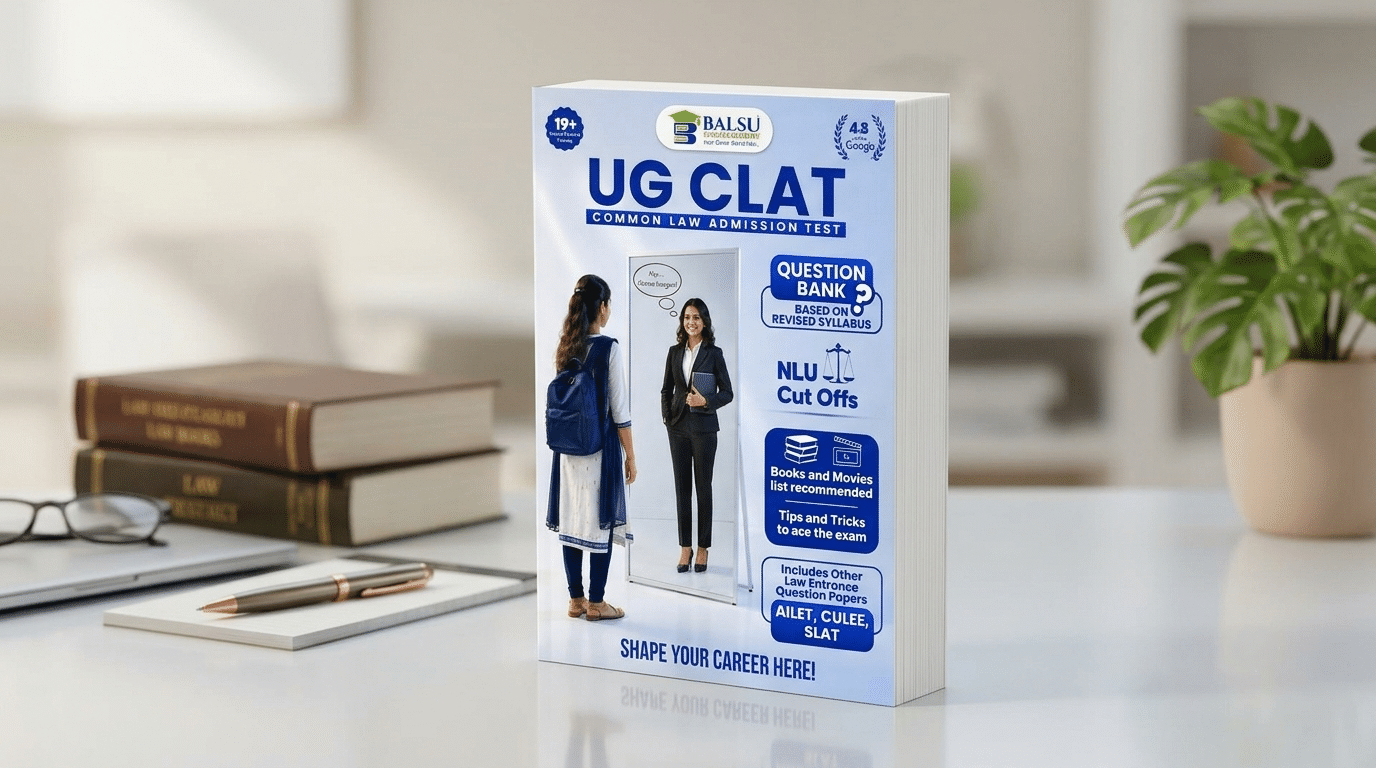
Balsu Success Academy is pleased to launch its own UG CLAT preparation book — a question bank based on the revised CLAT syllabus, published directly by Balsu and developed for students preparing for undergraduate law entrance exams.
The book brings together practice questions, NLU cut-off information, question papers from other major law entrance exams, exam tips and a recommended reading-and-viewing list, so that an aspirant has the core of their practice in one place.
Why Balsu developed this book
Balsu Success Academy has been training students for competitive entrance exams for over 19 years, and Balsu Law Prep works with CLAT aspirants in Madurai every year. Over that time, our faculty have seen a recurring need: students want practice material that reflects the revised syllabus, sits in one book, and is easy to use alongside classes and mock tests.
This book was developed to meet that need — to give aspirants structured, syllabus-aligned practice and the supporting information, such as NLU cut-offs and other exam papers, that they otherwise spend time searching for.
Key features of the book
1. Question bank based on the revised syllabus
- The core of the book is a question bank aligned to the revised CLAT UG syllabus, so your practice matches the type of questions you will face in the exam.
2. NLU cut-offs
- The book includes cut-off information for National Law Universities, which helps students and parents set realistic score targets and understand what different ranks mean for admission.
3. Question papers from other law entrance exams: AILET, CULEE and SLAT
- Most CLAT aspirants also apply to other law entrance tests. The book includes question papers from AILET (All India Law Entrance Test), CULEE and SLAT (Symbiosis Law Admission Test), so students can get familiar with these formats without hunting for papers separately.
4. Tips and tricks to approach the exam
- A dedicated section shares practical tips for attempting the paper — the kind of guidance students usually pick up only after several mock tests.
5. Recommended books and movies list
- Reading widely and following current issues are central to CLAT preparation. The book includes a curated list of recommended books and movies to build reading habits, vocabulary and general awareness in a way students actually enjoy.
The five sections of CLAT UG
The revised CLAT UG syllabus, on which the question bank is based, covers five sections:
| CLAT Section | What It Tests |
|---|---|
| English Language | Reading comprehension, inference and vocabulary in context |
| Current Affairs, including General Knowledge | Awareness of recent national and international events through passages |
| Legal Reasoning | Applying given legal principles to fact situations |
| Logical Reasoning | Arguments, assumptions, inferences and critical reasoning |
| Quantitative Techniques | Interpreting numerical data from passages, graphs and tables |
How the book helps you approach CLAT questions
Because CLAT is passage-based, the way you approach a question matters as much as what you know. Regular practice from a syllabus-aligned question bank helps you:
- Read a passage once, with purpose, instead of re-reading it several times;
- In Legal Reasoning, apply only the principle given in the passage rather than your own outside knowledge of the law;
- Spot common traps in Logical Reasoning options, such as extreme words or out-of-scope conclusions;
- Build the speed needed to finish the paper within the time limit.
Exam strategies and preparation techniques
Along with the tips and tricks covered in the book, a few principles help most CLAT aspirants:
- Read every day. Editorials and long-form articles build the reading stamina that the passages demand.
- Practise in timed sets. Attempt full passages within a fixed time rather than solving questions at leisure.
- Review every mistake. Note why you got a question wrong — misreading, assumption or calculation — and track patterns.
- Be careful with guesswork. CLAT has negative marking, so attempt with judgement rather than marking every question.
How to use this book alongside coaching, mock tests and practice
A question bank works best as part of a routine, not as a replacement for teaching or full-length tests. A simple approach:
| Stage | How to Use the Book |
|---|---|
| While learning a topic in class | Solve the related questions from the book the same week to reinforce the concept. |
| Weekly practice | Pick one set from each section and attempt it timed; review mistakes the same day. |
| Mock test phase | After each full-length mock, return to the book to practise the sections where you lost marks. |
| Final months | Use the AILET, CULEE and SLAT papers to prepare for other exams, and the NLU cut-offs to set score targets. |
Get your copy directly from Balsu
The book is available only from Balsu Success Academy. Fill in a short enquiry form and our team will call you with the details.
Who should use this book
1. Beginners in Class 11 and 12
- Students starting their CLAT preparation can use the book to understand the question types early and build steady practice habits.
2. Serious CLAT aspirants
- Students already preparing can use the question bank and other exam papers to add volume and variety to their practice.
3. Students who want structured preparation
- Aspirants in Madurai and across Tamil Nadu who prefer one organised resource over scattered material will find the format useful, whether or not they attend coaching.
4. Parents
- The NLU cut-off information gives parents a clearer picture of what scores lead to which law schools, which helps in planning applications.
Why choose Balsu preparation resources
- 19+ years of training students for competitive entrance exams in Madurai.
- 4.8 rating on Google from students and parents.
- Balsu Law Prep classroom coaching for CLAT, so the book is backed by faculty who teach the exam every year — explore our CLAT coaching in Madurai.
- Direct support: because you buy from Balsu, you can speak to our team about the book and your preparation.
Conclusion: start your CLAT preparation with the right material
The right CLAT preparation book will not do the work for you, but it can make your practice focused, consistent and aligned to the current exam. Balsu UG CLAT book brings syllabus-aligned questions, NLU cut-offs, other law entrance papers and practical tips together in one place.
To get your copy, submit an enquiry on the Balsu website or call us on +91 936 4444 662. Our team will contact you, explain the book and help you with the purchase.
Enquire about the UG CLAT book
Available only from Balsu Success Academy, Madurai.
Frequently asked questions
The book is sold only by Balsu Success Academy. It is not available on Amazon, Flipkart or other marketplaces. Submit the enquiry form on www.balsu.guru and our team will contact you with the price and delivery details and help you complete the purchase.
Yes. The book is a question bank based on the revised CLAT UG syllabus.
Yes. It includes question papers from AILET, CULEE and SLAT in addition to CLAT practice.
Yes. The book can be used for self-study. Students who also attend coaching or take mock tests can use it for topic-wise and section-wise practice.
Yes. Class 11 students can use it to become familiar with CLAT question types early, and increase the volume of practice in Class 12.